N8N Itu cocaine buat MVP — Native AI Yang Bawa Lo Ke Production
Lo dev, CTO, atau founder yang lagi prototype chatbot AI. Minggu pertama pakai N8N terasa kayak magic: drag satu HTTP Request node, satu Function node, satu WhatsApp Business API node, jalan. Demo ke stakeholder? Sukses. Lo pikir "yaudah tinggal scale aja".
Dua bulan kemudian, flow lo udah 47 node. Production chatbot dapet 200 chat per jam, latency 3 detik per response, error rate 8%, on-call tiap malem karena webhook ke-trigger dua kali. Billing n8n cloud naik 4x. Tiap tweak logic butuh redeploy, rollback penuh drama. Itu bukan production-ready, itu prototype dengan kostum production.
Di sisi lain, tim product yang udah production-grade pindah ke native AI — codebase sendiri, direct integration ke Gemini/OpenAI/Anthropic, full control tiap request. Bukan hype, ini pilihan teknis rasional yang kami bikin di ChatBot Cell setelah ngerasain dua-duanya.
Singkatnya: Native AI bukan buat flex, tapi buat production yang butuh latency rendah, cost predictable, dan kontrol debug end-to-end. Mau ngobrol teknis soal migrasi native AI?
Kenapa Tim Product Migrate dari N8N ke Native
N8N (dan low-code builder serupa) lahir buat satu use case: enable non-dev atau semi-dev buat automate workflow tanpa nulis kode. Buat MVP, ini super berguna. Buat production scale, lo kena trade-off:
- Node-based execution model punya overhead. Tiap request lewat scheduler, state manager, execution queue. Lo gak bisa langsung ke intinya.
- Visual abstraction nyembunyiin apa yang sebenernya terjadi. Saat production rusak, lo debug canvas warna-warni, bukan stack trace.
- Framework lock-in real. Migrate flow n8n ke platform lain = rewrite from scratch.
- Vendor ecosystem dependency — community node maintenance, n8n cloud pricing changes, version upgrade yang bisa break.
Tim product yang udah ngerasain pahitnya flow 50-node di production mulai mikir: "apa semua ini worth dibanding nulis 200 baris TypeScript yang handle exact same logic?". Jawabannya sering kali: nggak.
7 Kelebihan Native AI Dibanding N8N Buat Production
1. Lower Latency — Tanpa Node Overhead
N8N eksekusi tiap flow lewat pipeline: trigger → queue → execution manager → node-by-node → state persistence → response. Buat workflow simple (3-5 node), overhead ini mungkin 50-100ms. Buat complex flow dengan HTTP chain? Bisa 500ms-1.5s cuma overhead orchestration, di luar latency API eksternal.
Native AI gak punya layer itu. Request masuk → router → handler async → API call → response. Path langsung. Di ChatBot Cell, request topup pulsa customer cuma lewat 3 layer: WA webhook → intent classifier → transaction executor. Total overhead codebase kita ~80ms, sisanya latency network + Gemini API.
Contoh konkret: di n8n, kalau lo mau ngehandle intent customer ("saya mau pulsa 50k ke 0812xxx"), lo butuh minimum node ini:
Webhook → Set Variables → HTTP (Gemini API) → Function (parse JSON) →
IF (intent == topup) → HTTP (cek inventory) → HTTP (generate QRIS) →
WhatsApp Send → Update Sheet
8 node, masing-masing ada overhead serialization, JSON parse, expression evaluation. Native TypeScript? Fungsi async tunggal yang await tiga API call, parallel di mana bisa.
2. Full Control Debug — No Black Box
Production AI chatbot bakal rusak. Pertanyaannya kapan dan kenapa, bukan apakah. Saat customer report "chatbot saya balasnya aneh banget", lo butuh:
- Stack trace lengkap dari request masuk sampai response keluar
- Logging terstruktur per stage (intent parse, entity extraction, API call, response generation)
- Replay capability — bisa reproduce request dengan data yang sama, lihat di mana failure-nya
N8N kasih lo execution log per node. Tapi insightnya terbatas: "node X error dengan pesan Y". Lo gak bisa lihat state internal model, gak bisa inject middleware buat instrument, gak bisa conditional log berdasarkan complexity request.
Native AI lo punya codebase sendiri → lo bisa tambah OpenTelemetry trace, Sentry breadcrumbs, custom logger, hot path profiling. Saat Gemini API tiba-tiba slow (latency 5x normal), lo bisa detect dalam detik dan fallback ke model lain. Di n8n? Lo baru tau pas customer complain.
3. Cost Optimization di Scale — Eksekusi Per-Node Itu Mahal
N8N charge per execution atau per active workflow (tergantung plan cloud vs self-host). Untuk 1.000 request per hari, harga n8n cloud bisa $50-200/bulan cuma buat orchestration layer, di luar API cost (Gemini, WhatsApp, dll). Buat startup Indonesia, itu Rp 750k-3jt per bulan overhead pure orchestration.
Native AI: lo bayar server (VPS $10-40/bulan buat traffic menengah), API cost (Gemini/OpenAI per token), dan waktu dev (sudah jadi investasi awal). Buat 10.000+ request per hari, cost per request jauh lebih rendah karena gak ada layer mark-up.
Lebih penting lagi, lo bisa optimize cost secara granular. Misalnya:
- Request simple ("harga pulsa berapa?") → route ke model kecil (Gemini Flash) → cost $0.0001
- Request kompleks ("saya mau refund transaksi X karena Y") → route ke model besar (Gemini Pro) → cost $0.005
Di n8n, conditional routing begini butuh IF node + Switch node + multiple HTTP nodes, masing-masing eksekusi di-charge. Di native, satu if (complexity > threshold) di kode.
4. Framework Lock-In Zero — Swap Model/Provider Kapan Saja
N8N punya node spesifik buat setiap provider: "OpenAI Node", "Gemini Node", "Anthropic Node". Tiap node punya schema sendiri, parameter berbeda, response format beda. Mau pindah dari OpenAI ke Gemini? Reconfigure node, update expression parsing, test ulang.
Worse: kalau lo pakai community node buat provider niche (Cohere, Mistral, Together AI), maintenance node bisa abondoned. Lo stuck di versi lama atau fork sendiri.
Native AI lo bungkus dalam interface sendiri:
interface LLMProvider {
  chat(messages: Message[]): Promise<Response>;
  stream(messages: Message[]): AsyncIterator<Chunk>;
}

// Swap Gemini ke OpenAI = ganti 1 file implementasi
Begitu lo define abstraksi provider, switch model = 1 baris config. Di ChatBot Cell kami sempet A/B test Gemini vs GPT-4o selama 2 minggu — swap cuma butuh 5 menit deploy. Di n8n? Proyek migrasi 1-2 hari kerja.
5. Custom Fit Use Case — General Framework Bikin Mediocre
N8N didesain general-purpose: bisa automate CRM update, sync sheet, send email, parse PDF, manage inventory. Powerful buat flexibility, tapi "one-size-fits-all" selalu jadi "mediocre at everything".
Saat lo butuh:
- Custom retry logic dengan backoff exponential + jitter
- Rate limiting per customer (VIP unlimited, reguler 10 req/jam)
- Conversation context yang persisten 7 hari
- Fallback chain (Gemini → Claude → GPT-4o kalau ada yang down)
- Transaction safety (idempotency key, dedup webhook, race condition handle)
N8N bisa sih, tapi butuh kombinasi Function node + Code node + Schedule trigger + Redis external. Lo pada dasarnya nulis code JavaScript di dalam node Code — yang artinya lo nulis native code dengan extra step dan tanpa benefit tooling IDE proper.
Native TypeScript: lo pilih library yang fit (ioredis buat queue, p-retry buat retry, pino buat logging, fastify buat HTTP). Lo define domain model sendiri, type-safe end-to-end. Hasilnya: codebase lean yang pas 100% sama sama use case lo.
6. Scalability Predictable — Horisontal Tanpa Drama
N8N self-host jalan sebagai Node.js process single-threaded (worker mode ada tapi still tricky). Scale horizontal butuh Redis queue mode, multiple worker instances, careful config. Banyak yang struggle pas traffic naik 5x — flow yang jalan smooth di staging tiba-tiba race condition di production.
Native AI lo design dari awal buat horisontal scale: stateless handlers, queue via BullMQ/SQS, idempotency built-in. Saat traffic spike (event promo, flash sale), lo scale worker tanpa mikir orchestration layer. Di ChatBot Cell, kami pernah handle spike 8x traffic saat ada promo voucher Mobile Legends — zero downtime, latency tetep <1 detik. Coba di flow n8n 50-node, kemungkinan besar bakal timeout.
7. Observability End-to-End — Lo Tau Semua Yang Terjadi
Production observability butuh 3 pilar:
- Metrics (request rate, latency p95/p99, error rate, cost per request)
- Logs (structured, searchable, per-request correlation ID)
- Traces (distributed, span per service boundary)
Native AI lo bisa pilih stack: Prometheus + Grafana + Tempo, atau Datadog, atau OpenObserve self-hosted. Lo inject trace ke tiap API call, lo alert kalau error rate >1%, lo set SLO p99 <2 detik.
N8N punya execution log, tapi observability terbatas. Lo gak bisa dengan mudah trace satu request lewat n8n → external API → database → response. Lo gak bisa define custom metric ("berapa % conversation yang close tanpa escalation?"). Lo gak bisa alert berdasarkan business logic. Untuk production AI yang serius, ini critical gap.
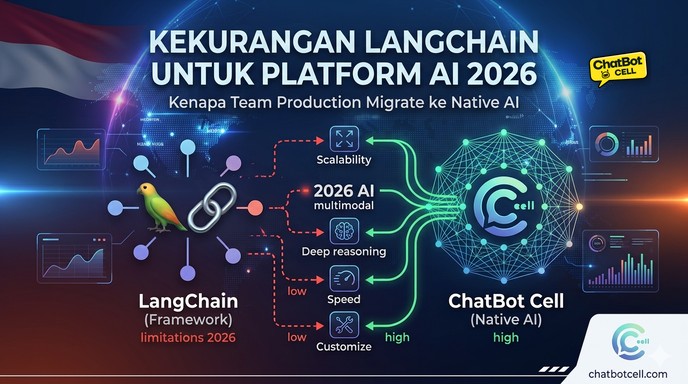
Tabel Perbandingan Native AI vs N8N
| Aspek | N8N | Native AI |
|---|---|---|
| Latency overhead | 200-1500ms (node chain) | 50-150ms (direct handler) |
| Cost per request | Orchestration markup | Pure API + server cost |
| Scaling | Worker mode tricky | Stateless, horisontal trivial |
| Flexibility | Drag node + Code JS | Full code, library bebas |
| Debugging | Execution log per node | Stack trace + tracing end-to-end |
| Vendor lock-in | N8N + node ecosystem | Zero (swap provider 1 baris) |
| Observability | Limited execution metrics | Full OTel/Prometheus/Datadog |
| Time-to-MVP | 1-3 hari | 1-3 minggu |
| Time-to-Production-Grade | Berminggu-minggu debugging flow | From day 1 (sudah production code) |
| Ideal use case | Automation internal, low traffic | Customer-facing, high traffic, critical path |
Case Study: ChatBot Cell — Dari N8N ke Native AI
Tim kami bukan teoritis. Kami udah jalanin dua-duanya. Asal mula ChatBot Cell sebagai chatbot WA buat topup pulsa, paket data, voucher game, token PLN — kami mulai dengan N8N bulan pertama. MVP jalan 2 minggu, demo ke early user sukses. Lalu production mulai dipakai.
Bulan ke-2 di N8N:
- Flow udah 35 node (intent router, inventory check, QRIS generator, struk sender, fallback chain)
- Latency p95 3.1 detik (customer udah pindah ke alfamart sebelum AI balas)
- Error rate 6-8% (mostly JSON parse error di Function node, atau webhook gak ke-fire)
- On-call tiap malem: webhook kadang ke-trigger dua kali, dedup manual pakai Redis Set
- Monthly cost: ~$180 buat n8n cloud + Gemini API + WhatsApp API
- Tweak prompt? Reconfigure HTTP node, redeploy flow, test end-to-end, 30 menit minimum
Migrasi ke Native AI (3 sprint, total 6 minggu):
// Approximate arsitektur ChatBot Cell sekarang
async function handleMessage(msg: WhatsAppMessage) {
  const intent = await classifyIntent(msg.text);    // Gemini Flash
  const ctx = await loadConversation(msg.from);      // Redis

  if (intent.type === 'topup') {
    const order = await processTopup(intent, ctx);   // Inventory + QRIS
    await sendWhatsApp(msg.from, order.qrisImage);
    return logTransaction(order);
  }

  const reply = await generateReply(msg, ctx);       // Gemini Pro
  await sendWhatsApp(msg.from, reply.text);
}
Hasil setelah native:
- Latency p95 0.8 detik (4x lebih cepat)
- Error rate <0.5% (mostly network timeout, auto-retry handle)
- On-call: 1-2 incident per bulan, semuanya auto-resolved
- Monthly cost: ~$120 (n8n cloud hilang, server VPS lebih murah)
- Tweak prompt? Edit config string, save, live dalam detik tanpa deploy
ROI migration: 6 minggu dev effort, payback period 4 bulan. Setelah itu, saving operational + revenue retention (customer gak kabur ke kompetitor karena slow) jauh lebih besar dari investasi awal.
FAQ Native AI vs N8N
Kapan N8N masih masuk akal?
Buat internal automation dengan traffic rendah (ratusan request per hari), tim non-dev yang butuh iterate cepat, atau use case yang gak critical-path buat revenue. Contoh: sync data CRM tiap malem, generate weekly report, send onboarding email sequence. Buat customer-facing chatbot AI yang handle transaksi, native lebih worth.
Kalau tim saya belum sanggup native, harus mulai dari mana?
Mulai dengan prototype di n8n selama 2-4 minggu buat validasi product-market fit. Begitu traffic >1.000 req/hari atau latency jadi masalah, mulai plan migration. Jangan rebuild dari awal kalau belum tau pasti use case-nya — n8n bantu explore cepat.
Berapa lama migrasi N8N ke Native AI?
Tergantung kompleksitas flow. Flow 20-30 node: 4-6 minggu. Flow 50+ node dengan banyak integrasi: 8-12 minggu. Strategi: parallel run selama 1 bulan, shadow traffic ke native, compare response, cutover begitu confidence tinggi.
Native AI gak punya downside?
Punya. Upfront engineering cost lebih tinggi — lo butuh dev yang ngerti async, error handling, observability, security. Lo butuh codebase maintenance (update dependency, fix bug, refactor). Buat founder non-teknis tanpa tim dev, ini bisa jadi blocker. Di situ vendor native AI seperti ChatBot Cell masuk — lo sewa engine production-grade tanpa nulis sendiri.
Apakah ChatBot Cell open-source engine-nya?
Nggak. Engine kami proprietary, tapi lo bisa lihat hasilnya di chatbotcell.com dan demo via WA. Buat dev yang mau DIY, kami happy share arsitektur high-level — chat teknis langsung.
Kesimpulan — Native AI Bukan Hype, Tapi Pilihan Teknis Rasional
N8N bagus buat satu hal: ngajarin lo soal use case AI di bisnis lo dengan cepat. Setelah lo tau pattern-nya, pindah ke native AI jadi pilihan rasional: latency 4x lebih cepat, cost 30-40% lebih murah di scale, debug 10x lebih mudah, observability end-to-end.
Bukan soal "N8N jelek" — N8N tool bagus buat use case yang tepat. Tapi buat chatbot AI production-grade yang handle transaksi customer, native menang di hampir semua dimensi teknis. Tim ChatBot Cell udah buktiin: 6 minggu migration, lifetime ROI positif.
Kalau lo lagi struggle dengan flow n8n di production, mungkin saatnya mikir migration. Mau diskusi arsitektur, audit flow n8n lo, atau demo native AI yang udah production-proven? Kami buka obrolan teknis tanpa sales pitch.